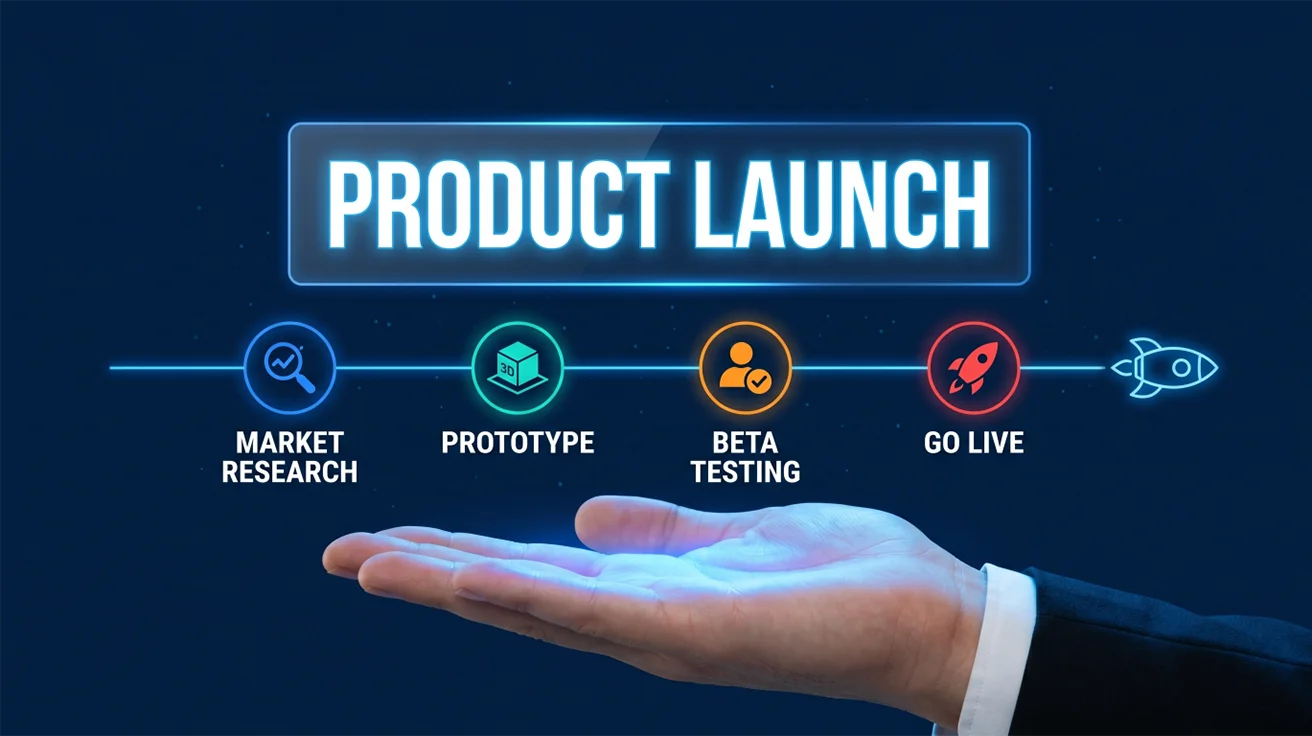
How New Product Testing Protects Businesses From Costly Launch Mistakes
New product testing is the step most businesses know they should take and most skip when the pressure to launch gets high. The deadline is close. The budget has already been spent on development. The team is confident. So the testing phase gets compressed or skipped entirely.
Then the product hits the market and the feedback is not what anyone expected. Sales disappoint. Customer complaints surface around issues that could have been caught earlier. The cost of fixing the product post-launch turns out to be significantly higher than the cost of testing would have been.
This pattern plays out across industries and company sizes. And it is almost entirely avoidable with the right validation process in place before launch.
Common Product Development Risks Businesses Face
Every new product carries risk. That is simply the reality of bringing something new to market. But not all risks are equal and not all of them are unpredictable.
The most common product development risks that businesses encounter include:
- Launching a product that solves a problem the target audience does not actually have
- Developing features that the development team valued but real users find irrelevant
- Pricing the product outside the range that the intended market considers acceptable
- Getting the packaging or branding wrong in ways that undermine the product’s appeal
- Entering a market segment where a competitor already dominates more thoroughly than initial research suggested
- Discovering manufacturing or quality issues only after the product is in distribution
Most of these risks can be avoided. They happen when development decisions are taken without consulting the consumer. Structured testing is just the right tool to uncover the types of product development risks that can cause big problems.
How Concept Testing Helps Businesses Evaluate New Ideas
Before significant investment goes into development, concept testing asks a fundamental question. Does this idea actually appeal to the people it is meant for?
A concept test presents the product idea, the core benefit proposition, and sometimes early visuals or prototypes to a sample of the target audience. Their reactions reveal whether the concept resonates, whether the stated benefit is compelling, and whether the intended positioning makes sense to real people rather than just to the team that created it.
Consumer insights research at this stage is genuinely valuable because it catches directional problems early. A concept that does not land with the target audience in testing will not land with them in the market either. Finding that out before development is complete costs a fraction of finding out after launch.
How New Product Testing in UAE Identifies Product Flaws Early
New product testing operates in a market with specific characteristics that make local testing particularly important. The consumer base is highly diverse. Buying behaviour, taste preferences, cultural sensitivities, and price expectations vary significantly across different communities.
A product that performs well with one segment of the UAE population may perform poorly with another. Testing in this market environment exposes these variations before launch. It identifies which product attributes drive acceptance across different groups and which create friction.
Testing prototype or pre-production products will help to identify functional problems that the internal teams may also miss due to familiarity. Original users will use the product in their convenient method that will be different from the people who built it. They identify friction points, confusing elements and performance gaps that usability testing reveals early and clearly.
Reducing the Risk of Launching the Wrong Product
One of the most painful and expensive product launch failures is not a product that underperforms on quality. It is a product that performs exactly as designed but fails because it was designed for a market need that was not as strong as assumed.
Product launch research validates the fundamental premise of the product before development resources are fully committed. Does the target customer actually want this? Would they pay for it? Does it improve on what they currently use in ways they consider meaningful?
These are not questions that internal teams can answer reliably about their own products. They require independent research with real members of the target audience. The answers sometimes confirm the development direction. Sometimes they reveal that a pivot or adjustment would significantly improve the product’s market fit. Either outcome is more valuable than launching without knowing.
Minimizing Market Entry Risks Through Early Validation
Entering a new market or a new category always carries uncertainty. Product validation research reduces that uncertainty by providing evidence about where the real opportunity sits and where the obstacles are.
Market entry risks that early validation can identify include:
- Category saturation where consumer loyalty to existing brands is stronger than expected
- Price sensitivity levels that make the planned pricing unviable for the target segment
- Distribution channel preferences that differ from what the launch plan assumed
- Regulatory or labelling requirements specific to the UAE market that affect product design
- Cultural considerations that affect how the product or its marketing will be received
Each of these risks is manageable when identified early. Each becomes significantly more costly when encountered after the product has already launched.
How New Product Testing Helps Improve Product Features
Testing does not just validate whether a product is ready. It tells you specifically what needs to change to make it better.
Product improvement research with target consumers generates direct feedback on which features they value most, which they find confusing or unnecessary, and which additions they wish the product had. This input allows development teams to prioritise the right improvements before finalising the product rather than adding them in a future version after launch.
Feature prioritisation informed by real consumer input produces products that are more focused and more aligned with what actually drives purchase decisions. It removes the guesswork from development decisions and replaces it with evidence.
Reducing Packaging and Branding Risks Through Consumer Feedback
Packaging and branding are where many otherwise good products lose. A product that works well but sits in confusing packaging, carries a name that does not resonate, or uses visual cues that send the wrong signals to the target consumer will underperform relative to its actual quality.
Benefits of product testing extend fully into the packaging and branding evaluation stage. Shelf impact testing shows how a product stands out or gets lost in a retail environment. Name and logo testing reveals how different branding options land with the target audience. Claims testing confirms that the language used on packaging communicates clearly and compellingly.
These are inexpensive adjustments to make at the design stage. They become expensive reversals after production runs have been completed and retail distribution has started.
How New Product Testing in UAE Helps Control Development Costs
There is a common belief that testing adds cost to product development. The reality is the opposite. Product testing UAE controls development costs by concentrating investment in directions that have been validated rather than those that are simply assumed to be right.
Development iterations guided by consumer feedback are more efficient than iterations driven by internal debate. Teams spend less time building features that testing has already shown are low priority. They spend more time refining the elements that testing has confirmed drive consumer preference.
Professional product testing services UAE that deliver solid, actionable results provide a development team with a prioritised roadmap instead of a general list of observations. The clarity helps to shorten revision cycles to a product ready-to-go stage and ensures development timelines and budgets are more predictable.
Preventing Negative Customer Reactions After Launch
A poor launch experience does not just cost sales. It costs reputation. In a connected market where reviews spread quickly and word of mouth moves fast across communities, a product that launches with unresolved issues faces an uphill recovery task.
Market research services focused on pre-launch testing identify the specific issues most likely to generate negative reactions before those reactions happen publicly. They allow businesses to address problems in a controlled environment rather than in front of customers, reviewers, and competitors.
Prevention is straightforwardly cheaper and less damaging than recovery. A product that launches cleanly builds reputation from day one. A product that launches with known but unaddressed issues spends its early market life managing criticism that a few weeks of additional testing would have avoided.
Using Survey Research and Consumer Insights to Reduce Business Risks
Structured survey research is one of the most practical tools in the product testing toolkit. Well-designed surveys reach large samples of the target audience quickly, quantify preferences and reactions across demographic segments, and produce statistically reliable findings that support confident decision making.
Consumer insights research through surveys answers the questions that observation and small-group testing cannot fully resolve. Which of three product variants do consumers prefer and by what margin. How does purchase intent change when price is adjusted? Which benefit statement resonates most strongly across different age groups.
These data points turn subjective product development debates into evidence-based decisions. They reduce the reliance on the loudest voice in the room and replace it with the measured voice of the actual market.
How Market Research Companies Support Risk-Free Product Development
A market research agency in UAE can add a structured approach, research expertise, and market knowledge with experience that internal groups usually do not carry. They put together research programmes that yield credible findings and keep the process unbiased.
They recruit representative samples from the right consumer groups. They analyse results with the context needed to translate data into actionable recommendations.
The relationship between a product development team and a research partner is most effective when it starts early. Not at the final pre-launch check but at the concept stage where research input can shape the development direction rather than just validate a finished product.
Research partnerships that cover the entire development cycle, from the early concept phase through to pre launch testing , tend to deliver the steadiest risk reduction results. They establish a feedback loop between the development process and the target market that keeps the product aligned with real consumer needs at every stage.
Conclusion
New product testing is not a cautious option for risk-averse businesses. It is a practical tool for any business that wants to make confident, evidence-based decisions before committing to a full market launch.
The UAE market rewards products that understand their audience. It moves quickly and competition is real. A product that has been properly tested, validated, and refined through genuine consumer feedback enters the market in a stronger position than one that was launched on confidence alone.
The cost of testing is the cost of knowing. The cost of not testing is the cost of finding out the hard way.
For professional product testing services, contact Think Positive. We offer product testing, consumer feedback analysis, and market research solutions to help businesses reduce risks and launch products with confidence.